


Oct 2, 2007 | NZPC

Mazda RX-2 - Prescription Medicine

Getting sick used to be an uncommon occurrence for me. Once a year I’d get a touch of the flu or a bit of a cough, but these days it happens far too frequently for my liking. Likewise, Shane McWatt and his aptly named SIKRX2 are suffering from an attack of a bug — the modifying bug. But, instead of trying to find a cure, he decided to feed the infection. Shane happily admits that he’s always had a soft spot for Mazda rotaries. But, of all the old-skool models, it is the RX-2 shape that always did it for him. So, it was only a matter of time before the right example came along and a project was started. It eventually came in the form of a factory-standard 1972 RX-2 sedan.

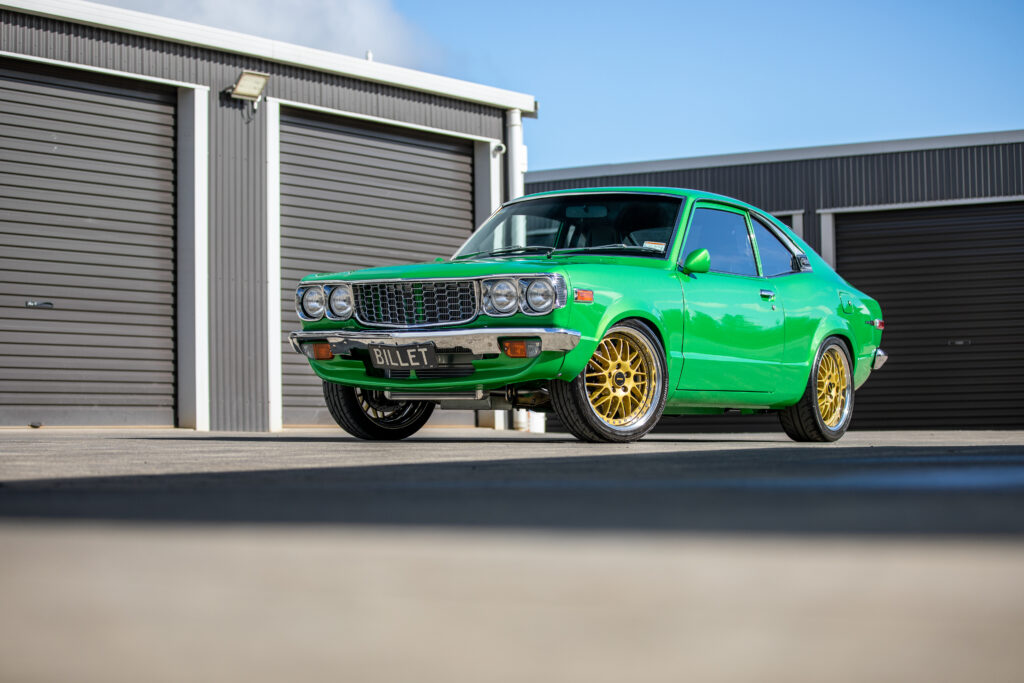
If modifying is an illness, then Shane McWatt got it bad with his stunning ’72 Mazda RX-2

The SIKRX2 build began by stripping the stock body back to bare metal so that the imperfections of the Mazda’s 34-year-old chassis could be remedied the right way. Once happy with the result, Shane had the crew at ITS Spray Painters coat the four-door in custom blue with an emerald green pearl. I think the chosen colour suits the box-like proportions of the sedan and the silky highlights only enhance the classic lines of this svelte, old-skool RX.

To compliment the look, the Mazda’s door handles and bumpers were re-chromed and a set of polished 16-inch Advanti Flash alloys with 205/45R16 Firestone Firehawk tyres were fitted. Hiding behind the polished rolling stock are Series Four RX-7 discs and callipers on all four corners. A Wilwood race-style pedal box replaces the old setup and in doing so the brake booster has been removed. To add stability and give the RX-2 a tough, squat stance on the road a set of Koni adjustable shocks were added with some King springs slotted in to keep things on the down low.

But it’s under the bonnet where SIKRX2’s real magic has happened. While it’s more common in New Zealand to take the naturally aspirated Bridgeport path with old Mazda repowers, Shane opted for something with a little more power: a 13B turbo engine lifted from a Series Four RX-7. The twin-rotor motor’s internal spec remains factory true except for some stage-two porting. Still, it has that classic rotary pulse that makes these cars so popular aided by a high-pitched Gilmour drive belt setup.

An internally-wastegated Garrett T04E huffer is Shane’s turbo of choice. This runs through a K&N air filter, polished piping and into the front-mounted Galant VR-4 intercooler. Once chilled, the air passes through the Series Four throttle body before being hit with fuel from a pair of 12A turbo injectors and combusted inside the engine. The fuel load is supplied by a Facet pump feeding into a custom surge tank.

A Bosch 044 fuel pump has also been employed in the setup to draw the go juice and pump it through to the Malpassi fuel pressure regulator. The spent gases are then fed into a custom exhaust manifold to spool the turbo one last time before running through a 2.5-inch custom exhaust and out via a polished three-inch stainless steel rear muffler.
A Microtech LTX-8 engine management system is the brains behind the operation — giving orders to the Bosch coils and aforementioned injectors. With a custom alloy radiator fitted, twin 10-inch electric fans and a Series Four RX-7 oil cooler, Shane can rest assured that his SIK little Mazda won’t have any of the overheating problems that often plague these set-ups. A Racepro vented catch can has been added to eliminate any spillage from oil blow-by. The under-bonnet look was finished off with various braided and silicone hoses and some aluminium detailing.

“The Mazda has hit the dyno a couple of times since its re-build and on the latest run it whipped up a tyre-frying 298hp at the treads on 13psi boost”

The engine spec is impressive for what’s mainly a street-driven machine. It begs the question: what sort of power does it make? Well, the Mazda has hit the dyno a couple of times since its re-build and on the latest run it whipped up a tyre-frying 298hp at the treads on 13psi boost. In practical terms, that’s like a storming 13.2-second quarter mile pass, with, of course, its fair share of wheel-spin.

Helping (or at least trying) to get the power to the ground is a Series Five RX-7 five-speed box with a 14lb flywheel — an ideal weight for street and strip applications. The standard-spec Series Five clutch has held up its end of the bargain so far, so it still remains. The box runs into a custom-built driveshaft by Beatties’ Driveshafts, with a 4.8:1 Toyota Hilux LSD differential setup out the back. It’s a pretty tough setup and, aside from grip issues at full boost, really gets the job done.

Step inside in the RX and apart from the pair of blue Racetech bucket seats and the rear-mounted half cage, one of the first things you notice is the custom made carbon fibre dash that houses a bunch of VDO white-faced gauges. Now, I don’t know about you, but I’ve always been a bit old-skool when it comes to classic rotaries and other Japanese cars of this era. So, I would have thought carbon fibre had no place in a car of this vintage. But Shane’s efforts have well and truly changed my mind. It really does look superb and not at all out of place with the rest of the car.

A Momo Race steering wheel and a rotor-shaped gear knob plucked from a new RX-8 complete the hands-on driving part of the equation. When Shane’s not changing gears or turning corners in anger, he’s cranking his tunes on a blue-lit Panasonic headunit and Rockford Fosgate 6x9s. The interior trim has been re-covered in tan vinyl with subtle finishing touches like SIKRX2 insignia stitched into the front doors and cobra door lock pins. It’s a really clean package.

After owning SIKRX2 for the last four years (with the last three being in the build) I think Shane may finally be in remission from his highly infectious disease. Now it’s time to drive and show off his creation to the masses. But for how long is anyone’s guess. In this game, we all know just how high the chances of re-infection are.

Driver Profile

Shane McWatt

Age: 25

Occupation: Earthmover

Previously owned Cars: Mitsubishi Galant VR-4, Mercedes-Benz 190E

Dream Car: Mazda RX-8 with a 26B-PP engine

Why the RX-2? I have always wanted a rotor and like the shape of the RX-2 the best

Build Time: Three years

Length of ownership: Four years

Shane Thanks: Chris for the interior work, Waiuku Automotive, ITS Spraypainters, Waiuku Radiator and Muffler Shop, Harkin Boat Builders, East Tamaki Auto Electrical, Dave Bray Engineering and all my mates and family for their help with the project

Tuning Menu

Mazda RX-2


Engine: Series Four RX-7 13BT, standard internals with Stage-Two porting, Garrett T04E turbo, K&N air filter, Turbosmart Supersonic blow-off valve, Bosch 044 fuel pump, Malpassi FPR, 12A turbo injectors, Bosch coils, Galant VR-4 intercooler, custom alloy radiator, Series Four RX-7 oil cooler, custom exhaust manifold, 2.5-inch custom stainless steel exhaust, polished three-inch stainless steel muffler, Microtech LTX-8 engine management system, Racepro oil catch can, Samco silicon intercooler hoses

Driveline: Series Five RX-7 five-speed gearbox, 14lb custom flywheel, factory S5 RX-7 clutch, Toyota Hilux 4.8:1 LSD diff, custom made driveshaft

Suspension/Brakes: Koni adjustable shocks, King springs, adjustable camber plates, Series Four RX-7 discs/callipers, Wilwood pedal box

Wheels/Tyres: 16-inch Advanti Flash alloys, 205/45/R16 Firestone Firehawk tyres

Exterior: Custom blue paint with emerald green pearl, Solex locks, re-chromed bumpers and door handles

Interior: Custom carbon fibre dash, VDO — speedometer, tachometer, water temp, volt, boost, oil pressure and fuel gauges, Racetech front seats, Panasonic headunit, Rockford Fosgate 6×9 speakers, tan vinyl re-trim, custom rollcage, cobra lock pins, Momo Race steering wheel, RX-8 gear knob

Performance: Dyno Power — 298hp at the wheels on 13psi, 0-400 in 13.2-seconds

Oct 2, 2007 | NZPC

Nissan R34 GT-RM Spec NUR - Gold Rush

Perfection means different things to different people. To me, this car is the epitome of perfection. Not in every sense of the word — you can’t be perfect at everything after all. But this car is the ultimate tool to use when you’re particularly keen on wiping the smug smirk off the face of a 30-year-old stockbroker who just splashed out on a $300,000 Porsche Carrera. Don’t get me wrong, I love Carreras and would own one any day. I never will of course.

Trouble is; anywhere you go in the world, you will find a certain group of people who have stumbled across enough money to buy cars we would all love to own. This is fine, but for some reason they suddenly feel that their ride puts them above the rest of us. It is the responsibility of people like us to remove the supercilious smirks from their dials. Agreed? Good. Okay, so about the world’s greatest car.

It cost over $350,000 to build and with boost twisted up, it cranks over 700hp at the flywheel. So, is the car dubbed GTRR New Zealand’s finest import street machine?

A standard BNR34 GT-R is legend enough, let alone one with a history as special as this one. This is a GT-R hand crafted by legendary Japanese tuner Trial. Yep, that big-buck tuning house is responsible for this bad-boy and what is probably one of its wildest creations is now owned by Christchurch flyboy Andrew Currie.

Andrew was not the one who phoned Japan and demanded this monster; that was the previous owner, who drove the GT-R for just three months before letting it go. Legend has it though that Trial sourced the car in Japan for the original owner, carried out the work at their home base over a 12-month period and then sent it down under. Want to guess the value of the modifications? What do you reckon: $50k, $75k, $100k? How about $280,000! We’ve seen the receipt. And add that to the value of this rare, 2003 M-Spec NUR model and you’re well into the $350K zone. That’s a pretty sweet figure, but then again, a substantial amount of work has gone in to this ride. For starters the capacity has been bumped up to 2.8 litres with an HKS Stage-3 fully balanced stroker kit. Combined with HKS forged pistons, you’re looking at one high-spec bullet-proof bottom end. That’s serious dollars people.

Perched on top of the super-dollar block is that famous head, which is well and truly kept in place thanks to HKS strengthened head bolts. An HKS 1.2mm steel head gasket keeps the gasses sealed in tight, while HKS adjustable cam pulleys are a nice addition and allow a little extra fine tuning to take place. The intake setup on this GT-R has to be one of the best around: twin HKS Super Power Flow filters, HKS joiners and plenty of shiny Nismo piping leading to a pair of HKS2530 turbos bolted to an HKS stainless manifold. Starting to see a trend here? The boost is fed through yet flashier Nismo piping to a massive Nismo intercooler where it’s then guided to a Nismo N1-spec intake. Once inside, the boost is mixed with a flood of juice from a Nismo fuel pump probably better suited to a 747-400. It’s regulated by a Nismo FPR and sprayed by a set of 800cc injectors plumbed into a Sard alloy fuel rail.

HKS M40 plugs set things off with a bang and the exhaust is vented through the HKS tubular manifold to a Mines four-inch titanium exhaust where it all ends at the matching handcrafted titanium muffler. The exhaust system alone cost over $7000! Like I said folks, not exactly your everyday list of mods here. With an engine like this, built to generate power figures well over 500hp, there is no way the standard cooling system would be up to the task. So Trial binned the lot and replaced everything with components more up to the job. A chunky Nismo radiator and N1 water pump keep the water jackets well fed with plenty of fluids while on the inside the oil duties are managed by a Nismo oil pump, oil pan and oil cooler.

“The standard gearbox remains in place, but as you can imagine, any car with this sort of grunt is going to make pretty short work of a standard clutch”

Just as important is a well-spec’ed computer setup. An HKS F-Con V Pro takes the reigns from the standard computer and maintains that fine balance of fuel and ignition timing, while an HKS EVC controls boost levels perfectly. Trial didn’t just focus on the 'go’ factor. The engine bay has just the right amount of show to match. A stainless steel ARC oil catch can, plenty of Samco silicon hoses and a trick carbon fibre air guide from Garage Defend combine with the alloy piping to give this bay just the right look. Impressive on paper, and equally impressive on the ST Hi-Tec hub dyno, the GT-R was good for 424kW and 274kg/m of torque at the wheels. That’s over 700hp at the flywheel in old money and more than enough wick to skin a Porsche.

It was short-lived though. A stroke of bad luck saw the head gasket blow. The RB engine was removed, shipped back to Japan and rebuilt. Happy with the power output, but knowing a fatter torque curve could be achieved with lower boost, Trial added an HKS V-Cam setup. This is something you won’t see every day and allows use of 272-degree cams without the usual driveability problems. An in-car control unit takes RPM and throttle opening inputs into account and then calculates the optimal cam timing to make the most of the higher lift while maintaining everyday driveability.

The engine was returned to New Zealand with the Trial boss in tow. Back on the dyno, boost was decreased from 1.66kg/cm (24.5psi) to 1.46kg/cm (21.5psi), resulting in a lesser maximum power figure of 340kW at the wheels, but far greater torque from 2000rpm to 4000rpm — perfect for the street. The standard gearbox remains in place, but as you can imagine, any car with this sort of grunt is going to make pretty short work of a standard clutch. Keeping with the theme of quality, Trial cracked open the ’box and installed a Nismo G-Max twin plate unit which is a little more up to the task at hand. As it stands, Trial left the original M-Spec struts and springs in place but added the planet’s fattest strut brace to the tower tops in an effort to prevent chassis twisting brought on by warp-factor-nine cornering.

Wheel choice is always an issue, not just in terms of appearance, but weight as well. You have to find that balance between something that looks good, but doesn’t slow you down. To do that though, you’ve got to spend the cash. A set of staunch yet lightweight 18×9.5-inch forged Nismo LM GT4 rollers have been colour-matched and bolted to the hubs to give a seriously purposeful stance. And because it’s fun to go fast, you need to stop just as quickly!

“In fact, GTRR has just about enough of everything to share around, but somehow I doubt Andrew would be quite so willing to sell for parts”

There are definitely no issues in that department on Andrew’s M-Spec. Up front, callipers from a Ferrari F50 fitted with Nismo pads clamp the huge slotted discs, while Nismo braided brake lines ensure there are no awkward explanations to the cops. Even so, the brakes can’t be left to the task entirely, so a set of sticky 245/40ZR18 Yokohama AVS tyres help keep things under control. Most people would probably be happy with the standard appearance of an R34 GT-R. Hell, most people would be satisfied with the standard power too. You already know that’s all gone out the window, but what about the exterior? Same deal; the cash has well and truly been laid out in fine style once again.
Nismo takes centre stage in this department with Z-Tune side skirts, a Z-Tune front bumper and a carbon fibre bonnet complete with cold air intake. As if that wasn’t enough, there’s also a carbon fibre under-tray for a little aerodynamic enhancement, as well as a tunnel brace on board for some extra rigidity. It’s all set off with M-Spec limited edition gold paint, tinted windows and Nismo GT taillights.

If ever the saying “but wait, there’s more” was appropriate, it’s right here. Trial is a workshop, not an interior design-house right? It seems I may be wrong. The standard GT-R M-Spec heated leather seats are ultra-cool, as is the A’PEXi turbo timer, but how about the $23,000 worth of carbon fibre plastered around inside? Look around and savour it in all its lightweight, weaved glory! The centre console, the underside of the front seats, the door trims, doorsills, the kick-panels, the steering column shroud — Christ it’s everywhere!

This is the kind of interior every male reader should be prepared to give their left nut for. And I’m not kidding either. What more can I say — carbon fibre is the coolest material you can possibly have inside your car and this thing has enough on board to donate to others not so fortunate. In fact, GTRR has just about enough of everything to share around, but somehow I doubt Andrew would be quite so willing to sell for parts. I guess I wouldn’t either if I had his car parked in my garage. I just hope there are a few 30-year-old stockbrokers out there who have gone home and cried to their 18-year-old girlfriends about how their Porsche just got beaten by some punk in a gold Nissan.

-RM Spec NUR – Gold Rush – 118

Driver Profile

Andrew Currie

Age: 26

Occupation: Pilot

Previously owned cars: Nissan R34 GT-R, Mitsubishi GTO, Honda CRX, Honda Prelude, Subaru Ute, Nissan Safari, Series 2 Land Rover.

Dream car: Ford Mustang GT 500 Eleanor Edition

Why the GT-R? Love the GT-R’s. This one came up for sale and had been done by professionals in Japan with no expense spared, and it’s a limited M Spec NUR.

Build time: 26 years of saving

Length of ownership: 4 months

The GT-R’s history: Built by Trial Motorsport in Japan

Other interests: Quad bikes, Snowboarding and going on holiday.

Andrew thanks: Trial Motorsport Japan, Steven, Amy, Daniel, Jon at Spec Performance 027 425 3433, friends and family

Tuning Menu

2003 Nissan R34 GT-R M Spec NUR

Engine: RB28DETT DOHC 24V, HKS 2.8 stage 3 stroker kit, HKS forged pistons, HKS 1.2mm head gasket, 2 x HKS 2530 turbos, HKS F-Con V Pro, HKS EVC, HKS V-Cam, HKS head bolts, HKS cam pulley, bored head (block), honed and balanced (block), HKS pod filters, Neko air flow meter, Nismo piping, Nismo N1 intake, Nismo intercooler, Nismo fuel pump, Nismo 800cc injectors, Nismo fuel regulator, HKS M40 plugs, Mines titanium muffler, Mines 4-inch titanium exhaust, HKS stainless manifold, Nismo radiator, Nismo oil pump, Nismo oil pan, Nismo oil cooler, N1 water pump, carbon air guide, ARC oil catch tank, Samco hoses.

Driveline: Factory 6-speed gearbox, Nismo G-Max twin plate clutch, Nismo big operating cylinder.

Suspension/Brakes: Nissan M-Spec shocks, M-Spec springs, HKS Kansai strut brace, Brembo F50 brakes, Nismo pads, Nismo hoses.

Wheels/tyres: 18×9.5-inch Nismo LM GT4 rims, 245/40R18 Yokohama AVS tyres

Exterior: Nismo Z-Tune side skirts, Nismo Z-Tune bumper, Nismo carbon bonnet, Nismo carbon under tray, Factory M-Spec limited edition Gold paint, HKS Kansai tunnel brace, Nismo GT tail lights.

Interior: Full carbon / leather interior, GT-R M-Spec seats, standard GT-R M-Spec steering wheel and gear knob, A’PEXi turbo timer.

Performance: Dyno Power — 424kW, 274kg/m @ wheels (1.66kg/cm boost), 340kW, 245kg/m @ wheels (1.46kg/cm boost)

Sep 29, 2007 | NZPC

PC 117 Anatomy of Speed Silvia S13

Every few years a vehicle comes along that stands out from the rest. There have been show cars such as Mike Rust’s EVLR32 and Azhar Bhamji’s NFULFX, or drift machines like Adam Richards’ HKS S15. Simon Dudding’s tube-frame Nissan Silvia has never screamed 'look at me’ like the others — until now.

If you think building a drag car is an expensive task, check out how Simon Dudding built his eight-second Silvia — you’ll be impressed

Four years ago, the 21-year-old Auckland printer was crewing for workmate and well-known V8 drag racer Lez Hurst. But after watching from the sidelines for a few years, he decided he wanted a piece of the hot seat action.

Simon purchased the S13 as a rolling shell. In a previous life it had already been campaigned on the strip and came complete with a steel tube frame and fibreglass body. With an injected Ford V8 up front and big slicks out the back, its best ever ET was a 9.3-second pass.

When he bought it, Simon was tossing up between keeping it V8-powered or heading down the import path. The decision took year to make and thankfully, the outcome was to run it with a late-model Japanese engine.

With the V8 crew still whispering in his ear, Simon knew there was truth in the saying: 'You can’t beat cubic inches’.

With that, he decided the best engine would be a three-litre RB30 Nissan item. Instead of fitting a mega-dollar block and building the car around it, Simon and friends visited the local Pick-A-Part, self-help wrecking yard to find a motor. Luckily, they happened across an old Nissan Skyline. With 300,000 clicks on the clock, the engine was only ever meant to be a dummy motor allowing the lads to fabricate the all-important engine mounts.

As a temporary measure, the block was fitted with an RB25 non-turbo head with a custom turbo setup. Since the engine was sitting in place, it made sense to wire it up for testing. With the help of Lez, a two-speed Powerglide transmission was fitted with extra clutch packs and a TH400 input shaft added. The car was then tuned by Kiwi-RE.
On its first outing with its $50 engine, the car stunned everyone by running a 10.84 @ 182kph (113mph) and joined the NZPC 10-Second Club.

Simon then teamed up with Kerry and Regan from Top Gear Autotech (TGA) and the car underwent a lot more work. Its best ET to date is an impressive 8.94 @ 232kph (144mph) — a pass achieved with less than 500hp at the rear wheels. Since the end of the 2005/06 racing season, Simon and the TGA team have spent some serious hours on the Silvia. The Pick-A-Part motor has finally been retired and replaced with a more serious drag-specific package. For the build, another RB30 block was sourced and fitted with Argo rods, JE pistons and ARP studs.

Attached to the engine are last season’s beautifully crafted TGA tuned-length 6-2-1 stainless steel headers. The GT3540 turbocharger that propelled the car into the NZPC 8-Second Club is gone, swapped out in favour of an HKS T51R SPL. Those who know their turbos will know that this in itself has the potential to create a whole lot more power. The boys didn’t stop there. The original plenum chamber was superseded by the mother off all intakes with a nine-litre capacity.

With the switch to methanol, the PWR icebox was replaced by four-inch intake piping and a TGA 100mm throttle body.

To cope with the huge jump in flow rates, a second Turbosmart blow-off valve was added, along with a 48mm Turbosmart external wastegate. Both the screamer pipe from the wastegate and the four-inch exhaust from the turbo vent directly out the side of the vehicle.

The previously stock RB25DE head is now fitted with a bunch of HKS gear, including cams, pulleys and a metal head gasket. Simon has also spent many hours with the die grinder opening the ports up as much as possible to improve flow rates.

With methanol comes the need for a whole new fuel system. A cam driven Aeromotive mechanical pump now sends fuel to twin fuel rails from a small alloy tank that sits in the engine bay. One rail was fitted with 1800cc injectors, while the other has 700cc items. Both are under the control of Turbosmart fuel pressure regulators. The previously fitted MicroTech LTX-12S and Turbosmart eBoost are still in charge of managing the new setup.

While the combination has yet to be tested, there will obviously be far more power than when last raced. Last season the driveline was heavily modified with the Ford nine-inch diff housing strengthened, fitted with Moser 31-spline axles and a full spool centre.

“Its best ET was an impressive 8.94 @ 232kph (144mph) — a pass achieved with less than 500hp at the rear wheels”

Wheelie bars were also a late-season addition — not by choice, but by necessity. At the NZDRA Nationals, the track was so sticky on the launch that the front end lifted and the car nearly flipped. Unfortunately, the return to earth was equally as rapid, resulting in some serious damage. One of the items that came to grief was the engine’s sump. In its place is now a custom TGA steel sump with external oil pickup plumbing.

The super-sticky rear wheel and tyre combo responsible for the flying start are 15×12-inch Weld Prostar rims with 32x14x15-inch Mickey Thompson slicks. Up front these are matched with narrower 15×4.5-inch wide rims wearing Mickey Thompson Front Runners.

The front suspension and chassis rails were also damaged during the fall, but some repairs saw the vehicle through to the end of the season. During the latest upgrades, these were removed and completely rebuilt.

“At the NZDRA Nationals, the track was so sticky on the launch that the front end lifted and the car nearly flipped”

Now attached to the new TGA chassis-work are Bilstein coil-overs wrapped in springs made by Chris at Suspension Technology. The back third of the chassis was also rebuilt and fitted with an adjustable four-link setup.

For suspension, the team chose to run tried-and-tested, drag specific QA1 coil-overs. During the rear end rebuild a parachute was installed, although the Silvia also runs its Skyline front discs and Ford rear drums. The interior is strictly a business affair. Surrounded in a sea of aluminium panelling, Simon sits in a custom seat on the left side of the vehicle. In front of him is a custom steering column fitted with an Auto Meter Pro Comp tachometer and Auto Meter oil pressure gauge. Even though the car has a full fibreglass body and Lexan windows, its steel chassis means it still weighs in at a comparatively hefty 950kg (including driver).

The most impressive thing about this car is not the power produced, nor the time achieved — it’s the fact that it has been done on such a modest budget. In fact, I would say that few vehicles running in the 10-second bracket would have cost as little to build as this Silvia.

Sure Simon has picked up a few good deals on the way, but the main reason for the low build cost is the vehicle’s relative simplicity.

Essentially the car is built as an import-powered Door Slammer, using a proven driveline package combined with a proven engine combination. Simon’s consistent driving is also one of the reasons for the vehicle’s success. At the 2006 NZPC versus NZV8 Drag Masters event, he was quite possibly the most consistent driver at the meeting. Unfortunately, his competition on the day had a power advantage, so he was not rewarded for his efforts. In the years to come, we are bound to see more and more import vehicles built in the style of Simon’s, yet his modest attitude to the vehicle’s successes would make you think its still running 13-second passes.

While in Simon’s possession, the car has only raced for two seasons, but in that time has managed to jump from running high 10s to a best of 8.94. With that sort of improvement, I’d say it won’t be long before we see the team in the seven-second bracket, especially when you remember the eights were run with less than 500hp and the vehicle now has closer to 800hp. What’s more, the car has cost less to build than what other teams spend on a whole season.
Now that’s impressive!

Driver Profile

Simon Dudding

Age: 25

Occupation: Printer

Previously owned cars: TA22 Celica, RA28 Celica, 74 Mitsi GTO, 72 HQ Holden

Dream car: 6-second Turbo Pro Modified car

Why the Silvia: To have fun with my mates, and go real fast

Build time: 3 years

Length of ownership: 4 years

Simon Thanks: Podgy, Snowy, Lez Hurst and family, Kerry, Adam, Caro, Terry Bowden, the olds, Top Gear Autotech, Darryl and Steve at Redline Performance, Kiwi-RE, Speedy Racewear, Ride Cycles, NRB Performance, Suspension Tech, United Flexible, Brown Brothas Industries, Brent at Curren Brothers Racing and any other monkeys that have helped or supported me over the years

Tuning menu

1991 Nissan Silvia S13

Engine: RB30DET, ARP head studs, Argo conrods, JE pistons, RB25 head, ported, HKS cams, HKS pulleys, HKS head gasket, Top Gear Autotech (TGA) plenum, TGA 100mm throttle body, 4-inch stainless intake, HKS T51R SPL turbo, 2x Turbosmart blow-off valves, Turbosmart 48mm Progate wastegate, Aeromotive mechanical fuel pump, 6x1800cc injectors, 6x700cc injectors, 2x Turbosmart fuel pressure regulators, 4-inch exhaust, 2-inch screamer pipe, Mocal trans cooler, MicroTech LTX-12S ECU, Turbosmart e-Boost controller, custom alloy fuel tank, TGA custom sump, TGA tuned length 6-2-1 headers

Driveline: 2-speed Powerglide (Lez Hurst) T400 input shaft, high stall torque converter, TGA 9-inch rear end, Moser 31 spline axles, full spool centre, custom driveshaft

Suspension: Front — Suspension Technology Bilstein coil-overs, QA1 rear coil-overs, custom front springs, TGA adjustable 4-link rear, TGA chromolly wheelie bars

Brakes: Skyline discs, 2-pot callipers, Ford rear drums, parachute

Wheels/tyres: 15×4.5-inch Weld Racing Prostar front rims, 15×12-inch rear, 25×4.5×15-inch Micky Thompson fronts, 32x14x15-inch Micky Thompson rear

Exterior: Full fibreglass body, 1-piece front, TGA rear wing, Citroen silver paint, Brown Brothas Industries graphics

Interior: Steel tube chassis, custom alloy panelling, Lez Hurst Reactor shifter, Autometer gauges, Microtech hand controller, RCI harness, custom seat

Performance: 8.94 seconds @ 144mph (old setup)

Sep 28, 2007 | NZPC

1975 Mazda RX-3 Savanna

Inspiration to build or modify a car comes in many different forms. For those still at school, the main inspiration is the cool factor or to gain the attention of members of the opposite sex. For me it was power — or lack of it — that got me started. I learnt to drive in my sister’s 850cc Mini, which was understandably lacking in the grunt department. So, when I got my first car, it had to have more. Having more power than a 0.85-litre Mini is an easy task, but I wanted a lot more. To this day, I still do. Is there really such a thing as enough power?

What do you do when your dreams become reality? Upgrade your dreams, of course

Gary Downs first started modifying in an attempt to turn a beaten up 1975 Mazda RX-3 into his dream car. In his mind he pictured a perfectly presented ride with an equally impressive engine. In reality, this dream quickly became a nightmare.

First, the car was stripped back to a bare shell because Gary wanted to remove 25 years of grease and grime before attempting to straighten the shell. It wasn’t just a quick shot of Botox that saw this once-wrinkly lady looking smooth again — it was a whole lot of man-hours. A friend of Gary’s, Dave Matehaere, was the man with the spray gun who sprayed it with Peugeot deep blue paint. Having such a classic body shape, colour choice can either make or break the look of the car. Needless to say the chosen blue looks stunning.

The car in Gary’s dream had perfect chrome workhis didn’t. This sort of stuff is very hard to come by, as are the genuine badges, but Gary kept looking until he found what he was after. With these items fitted, it was time to sort the vehicle’s stance. KYB adjustable platforms were wrapped in King springs and fitted to the front end. Balancing out the ride are matching KYB rear shocks and re-set rear leaf springs. The result of the suspension combination is a reduction of three inches in the ride height. There’s also a lot less clunking thanks to a full course of Nolathane bushes that were fitted all round.

Gary chose to fit custom-built Simmons alloys to fill the wheel arches. While Simmons may be a common fitment to vehicles of this era, the Versus model Gary chose are not. He decided to keep the wheels a relatively small 16-inches in diameter, and wrapped them in 205/40R16 rubber, to fill the guards perfectly.

The idea of keeping the vehicle powered by a 12A was never considered. Instead, Gary fitted a larger capacity 13B twin rotor engine. Not just any old motor would do, as the plan was to make the old girl run as good as she looked. To build the tough engine package, Gary first sourced a Series 5 RX-7 13B turbo block. New rotors, complete with 2mm seals were also fitted. During the build, brand new housings were purchased and the end plate’s custom turbo ported for maximum power. A new clutch was then fitted and the entire rotating assembly balanced.

The RX-7 intake manifold has been retained, polished and fitted with a polished throttle body. Below the intake manifold and connected to the block is a custom exhaust manifold that mounts a hybrid TO4B turbo. The large turbo draws air from a custom intake that locates a pod filter directly behind a vacant headlight recess. Closer to the combustion chambers, 550cc primary injectors and 850cc secondary items supply fuel to the engine. These are fed by a fuel system consisting of a VL Commodore pump, stainless surge tank and a Holley Red pump.

“The idea of keeping the vehicle powered by a 12A was never considered. Instead, Gary fitted a larger capacity 13B twin rotor engine”

If the missing headlight doesn’t tell you that big power lives within, then the custom intercooler piping hanging below the front valance should. Mounted at the centre of the chromed piping is a large custom intercooler. It’s the RX-7 oil cooler that is visible though, as the intercooler hides higher up behind the grill.

Behind the firewall are four individual Bosch coil packs that provide spark to the engine through 9mm leads and NGK plugs. The separate coil pack arrangement receives orders via a Microtech LTX-8 sourced from Dyson Rotary in Australia. When installing the ECU, all wiring was hidden to keep the engine bay as clean as possible. Also aiding in that area is a custom alloy radiator and slim-line electric fan.

The original RX-3 four-speed cog swapper was replaced at the same time as the engine. In its place is a tougher five-speed box from a Series 5 RX-7. Further down the driveline, the entire rear end has been replaced with a Series 3 RX-7 disc-to-disc assembly complete with limited slip diff. To ensure the rear wheels don’t lock up before the fronts, Series 2 RX-7 front callipers have been fitted along with bigger rotors.

With the engine side of the package complete, the car was sent to Auckland Rotary specialists Kiwi-RE for tuning. The result being 300hp at the wheels on pump gas and low boost. While those sort of numbers may not be earth-shattering in these power-crazed days, believe me, it’s more than enough for a street car that weighs less than 900kg.

While the power-to-weight ratio has resulted in a decent 12.5-second quarter-mile run, the main focus for the vehicle was the street, not the strip. And as such the interior also required a thorough makeover. Instead of re-trimming the standard seats, a pair of Lancer Evolution Recaros were sourced and sent to the upholsterers, along with the rest of the interior. Every trim panel was treated to a fresh layer of black or white vinyl. The front and rear seats, while trimmed in a retro fashion, have been embroidered with the Savanna logo. This small touch breaks up the large black panels in the centre of the seats, as well as letting people know what the vehicle is. Instead of ruining the classic lines of the exterior or dashboard, Gary decided to fit the required gauges below the dash on the passenger’s side.

The gauges (measuring boost, oil pressure and water temp) are not the only electronic enhancement the interior has seen. Despite the stunning sound of the exhaust and Gilmour belt, Gary has fitted a decent audio system consisting of a Sony headunit, Fusion amplifier and Soundstream 6×9-inch speakers in the rear tray. With his dream ride complete, Gary decided to enter the 2006 NZPC 4 & Rotary Nationals, winning best RX-3. This mix of old school style and new school technology makes for one hell of a streetcar.

During the three year build, Gary’s dreams have shifted. Although he has achieved everything he wanted, the car will soon be sold. It’s not the end of Gary and rotaries though — he assures us his next project will be even better.

Driver Profile

Gary Down

Age: 24

Occupation: Contractor

Previously owned cars: 323 wagon

Dream car: The next one

Why the RX-3? It was my dream car at the time

Build time: Three years

Length of ownership: Six years

Gary thanks: My missus Olivia for all her hard work and patience, my good mates Luke Bond and Dave Matehaere, Dyson Rotary, Kiwi-RE and a big thanks to my family

Tuning menu

1975 Mazda RX-3 Savanna

Engine: S5 RX-7 13B turbo, new housings, new rotors, balanced rotating assembly, 2mm apex seals, custom porting, custom exhaust manifold, TO4B hybrid turbo, custom intercooler, GFB blow-off valve, 550cc primary injectors, 850cc secondary injectors, Holley Red fuel pump, VL Commodore fuel pump, stainless surge tank, 9mm leads, Bosch coils, NGK plugs, 2.5-inch exhaust, three-inch Dytech mufflers, alloy radiator, S5 RX-7 oil cooler, Microtech LTX-8 ECU

Driveline: Series Five RX-7 five-speed gearbox, S3 RX-7 limited slip differential

Suspension/Brakes: KYB adjustable platforms, King springs and Nolathane bushes

Brakes: S2 RX-7 callipers front, S3 RX-7 rear

Wheels/tyres: 16-inch Simmons Versus alloys, Ventus 205/40R16 tyres

Exterior: Peugeot blue paint, 35 per cent tints

Interior: Full re-trim in white, Recaro seats, Momo steering wheel, Sony head unit, Fusion amplifier and Sound Stream 6×9-inch speakers

Performance: Dyno Power — 300hp @ wheels, 0-400m —12.5-seconds

Sep 28, 2007 | NZPC

PC 117 Skyline Sovereignty GTR

Since the beginning of time, man has been trying to outdo man with faster, cooler toys. While time has marched on, that competitiveness has remained the same. Take your race car to the track, and although you think you’re quick, chances are someone will turn up with something quicker.

All hail Japan’s quickest track-spec GT-R this side of a Super GT machine

In Japan one of the fastest machines at the circuit belongs to Osaka tuner Nagisa Auto. For a few years now, its stunning BNR34 Nissan Skyline GT-R has decimated all who got in its way. Did we need any more reason to check it out? I don’t think so. As Nippon’s most celebrated performance car, the GT-R is a favourite among tuners. There’s a shit-load of over-the-counter parts available to turn your street machine into a 0-400m-blazing, expressway-eating monster and all without much effort. All you need is a fat wallet with
a serious yen injection! or some generous sponsors.

Knowing the right people in the right places, Nagisa Auto’s main man, Naoya Sugihara started with a stock R34 and went to work. The Skyline was stripped completely bare and its chassis prepared for competition duties. That meant the construction of an integrated chromolly roll cage and some tedious hours seam welding. Take a closer look and you’ll see that nearly all its joins were dealt to and that includes the underneath of the car.

While this was going on, Sugihara was already in the midst of a suitable engine build. The RB26DETT employed for the job was always destined to output big power, but its creator was more interested in how much torque it could produce. When it comes to GT-R power plants, the key is in big displacement — Sugihara found that in an HKS 2.8-litre kit. With forged pistons, forged H-beam rods and a Full-Counter crankshaft, the bottom end now beats to the tune of an extra 200cc of combustion room — small on paper perhaps, but big in real-world results. Balanced through a billet flywheel and Exedy twin-plate race clutch, the bones of the engine were ready for action.

Up top, the RB’s DOHC 24V cylinder head was on the flow bench getting the whole nine yards. A custom port job was matched with big Naprec valves and race-ready springs and the upper realms of the engine were almost ready to breathe in big gulps. All it needed was a pair of HKS Step-2 camshafts with 272 degrees of duration on the intake and exhaust sides complete with adjustable gears from the same maker.

The intake side of the torque-building equation was next on the list. The RB26’s factory twin T28 turbos were never going to be up to the challenge and were swapped for something with a little more presence. Through some well thought-out gear ratios and Sugihara’s aggressive driving style, boost lag was never going to be too much of an issue. With that in mind, Nagisa went down the 'big single’ path, fitting up a dinner plate-sized T88-33D on a high-mount Trust stainless manifold. The turbo setup is impressive looking and runs a massive Trust front-mounted intercooler with matching pipe work. A Trust racing wastegate bleeds off excess boost via an atmo’ venting down pipe, while exhaust gases exit through a custom Nagisa Auto NAMS titanium system.

Before the big six experienced a single revolution though, fire and fuel systems of an adequate magnitude needed to be installed. Housing a strict diet of high-octane jet juice, an ATL fuel cell literally dominates the boot cavity. Fuel pit stops are a breeze through the direct-feed filler — something of a regular occurrence given the appetite of the hard-tuned engine. A multi-pump setup feeds forward through big lines and into an adjustable fuel pressure regulator. From there, six 1000cc injectors squirt via an adjustable fuel rail into a row of 49mm Naprec throttle bodies. A NAMS custom-crafted plenum (surge tank) rounds out the intake workings nicely.

With all this generated energy comes heat, and too much isn’t good for an engine of this nature. Playing on the safe side of cautious, the RB’s water channels stay cool courtesy of an aluminium race radiator. A JUN pump keeps the oil moving and a custom cooler keeps the slick stuff’s temp in check. As you can see, the engine is one serious piece of performance hardware, but still required some clever tuning to unlock its full potential.

“At around 2kg/cm (30psi) boost a solid 750PS @ 7500rpm was being generated. That’s impressive, but it’s the torque numbers that you really need to hear about”

When it comes to that sort of stuff, Sugihara is a bit of gun and with an A’PEXi Power-FC wired into the engine loom, he got busy on the Nagisa Auto dyno. After a few hours worth of fuel and ignition map surfing, full power runs were laid down to reveal the results of all the hard (and expensive) work. At around 2kg/cm (30psi) boost a solid 750PS @ 7500rpm was being generated. That’s impressive, but it’s the torque numbers that you really need to hear about. How does a whopping 78kg/m @ 6100rpm grab ya? It’s no wonder Sugihara wears a neck brace when he drives this thing!

Drive is transferred through a Hollinger sequential six-speed gearbox running into OS Giken limited slip differentials. Although the transmission type does allow for clutch-free cog swaps, Suginara is a little gentler, preferring to kick the twin-plate clutch on each up-shift (pull back) and down-shift (push forward) on the stick.

To set the car up just right, a Field Torque Split Controller overrides the ECU-controlled front and rear division to give the GT-R drive bias options at the push of a button.
Being primarily a designer and hand-manufacturer of race-based suspension gear, it comes as no surprise that the GT-R wears a full underbelly of Nagisa Auto’s own gear. NAMS lower arms, roll centre adjusters and upper arms complement the CRUX adjustable shocks, and Swift 18kg front and 16kg rear springs. An Auto Select tower bar was installed to eliminate flex between the strut tops.

There were substantial enhancements made in the brake department. Although well-spec’ed from factory with a full course of Brembo loving, the GT-R now stops with six-pot front callipers from AP Racing on 390mm Craft Square vented rotors. Down the rear Nismo N1 callipers grab 333mm rotors with NAMS SPL brake lines squeezing through the high temp fluid. With the chassis and driveline package complete, Sugihara was chomping at the bit to hit the track and lay some beat down Nagisa Auto style, but there was still the bodywork and interior to sort.

For the exterior he called in a favour from Auto Select, who promptly hooked the brother up with a CFRP front bumper complete with carbon canards. Auto Select also threw in one of its bonnets and boot lids in stunning dry carbon, and M Speed gifted the side steps. All that was left was to re-spray the Skyline in Nagisa’s trademark silver hue, bolt on the Daishin carbon GT wing, fit a lightweight Speed Glass windscreen, pop in a pair of NAMS super-trick LED tail lights and the car was off to the sign writer.

“The 'Tokyo 5.0’ had just arrived and were hiding, waiting for someone to make a wrong move in this utterly street-illegal ride”

Now if that wasn’t cool enough, at the time of our shoot, Sugihara had been busy collecting the necessary bits and pieces to add some extra girth to the GT-R. Yes, think wide body. It’s something that now completed has made this track-weapon look even more sinister. Not being one to shy away of such a machine, I successfully managed to wedge myself in the carbon/Kevlar Bride seat. If anything,

I guess it gave me a good few moments to snoop around the cockpit while I planned my discreet, and graceful extraction from the race bucket. A suede wheel on a NAMS boss spacer is the tool for steering the beast and there’s a Sabelt harness to hold Sugihara in place when the horizontal Gs kick in. A MAX digital screen displays all the engine vitals, along with an HKS 2.5kg turbo meter, GReddy exhaust temperature gauge and an A’PEXi AVC-R for boost control. All housed with a custom, composite dashboard this is serious stuff.

Getting behind the wheel of this circuit stunner for a couple of laps is something I think I would happily trade my right nut for. Unfortunately for me, it wasn’t going to happen here in the car park behind the Nagisa workshop. More than anything because the 'Tokyo 5.0’ had just arrived and were hiding, waiting for someone to make a wrong move in this utterly street-illegal ride. Sugihara on the other hand has had ample opportunity to get the car out on the circuit since it was built back in 2003.

By tuned GT-R standards, the Nagisa Auto R34 is quick — lap record quick. And while this actually has a lot to do with Sugihara’s fortitude in the hot seat, there’s no denying how much importance the hardware makes. This side of the Japanese Super GT (JGTC) series, track-spec GT-Rs don’t come much better.

But like that age-old quest to push the limits of adhesion and test the theories of velocity, this Nissan’s development is far from over.

There are plenty of other fast Skylines turning up to race, but for now, Sugihara and his Skyline are the undisputed kings.

Tuning menu

Nagisa Auto BNR34 Skyline GT-R

Engine: Nissan RB26 DOHC 24V, HKS 2.8-litre engine kit — HKS forged pistons, HKS H-Beam con rods, HKS Full-Counter crankshaft, HKS Step-2 272-deg in/ex camshafts, Naprec valves & guides, Naprec 49mm throttle bodies, Trust T88-33D turbocharger, Trust exhaust manifold, Trust racing wastegate, Trust intercooler, NAMS titanium front pipe, NAMS titanium exhaust system, JUN oil pump, NAMS titanium oil catch tank, ATL fuel cell, A’PEXi Power-FC engine management system

Driveline: Hollinger 6-speed sequential gearbox, Exedy twin-plate racing clutch, OS Giken front/rear limited slip differentials

Suspension: CRUX fully adjustable shock absorbers (NAMS version) Swift springs — 18kg front, 16kg rear, NAMS lower arms, NAMS upper links, NAMS roll centre adjusters, Auto Select front tower bar
Brakes: Front — AP Racing 6-pot callipers, Craft Square 390mm vented rotors, Rear — Nismo N1 callipers, Craft Square 333mm vented rotors, SPL braided brake lines front/rear

Exterior: Auto Select front bumper, Auto Select dry carbon bonnet, Auto Select dry carbon boot, M-Speed dry carbon side steps, Auto Select carbon canards, Daishin carbon fibre GT wing, Speed Glass lightweight windscreen

Interior: Full chromolly roll cage, Bride carbon/Kevlar seat, NAMS low-mount seat rail, NAMS boss spacer kit, custom composite dashboard, MAX Multiple Meter display, Sabelt harness, HKS 2.5kg boost meter, GReddy exhaust temp meter, A’PEXi AVC-R boost controller, Field Torque Split Controller, plumbed fire extinguisher

Wheels/Tyres: Speed Star Racing 18x11J forged alloy wheels, Dunlop Direzza 03G

Performance: Dyno Power — 750ps @ 7800rpm, 78kg/m @ 6100rpm, Tsukuba Circuit — 56.397-seconds

Thanks: Sugihara at Nagisa Auto, Miyanaga at Testu Photo Japan, Rob at GRD NZ

Sep 28, 2007 | NZPC

PC 117 Piece by Piece Datsun
If I said the words 'rotary’ and 'explosion’, what would be the first thing that comes to mind? Without even thinking about it, you’ve thought those two words are synonymous with each other. However, if I was to say 'Datsun 1200’ and 'Toyota 3T-GTEU’, a lot of you would go 'huh?’ You wouldn’t consider the two in the same light.

Some things don’t go together, but that doesn’t mean they can’t work

Hawkes Bay man Ryan Ackroyd saw the potential though. And the combination is proof that while some things weren’t designed to be, it doesn’t mean they can’t produce a good outcome when put together. Unlike a lot ofPC 117 Piece by Piece Datsun Sep06 07.jpg cars, this little Datsun 1200 wagon traces it origins back to Australia, where it resided for the first 13 years of its life. The car then moved across the ditch to New Zealand in 1985.

At the time, the Datto was packing an A14, 1.4-litre push-rod eight valver fitted in Australia. But to give the wagon some more kick a set of CA18 injectors, a CA18 turbo and intercooler were added along with a three-inch exhaust. But it didn’t take long before the power plant melted, meaning either a rebuild or a new engine was on the cards.
Ryan’s hunger for power meant a new engine was the only option. Enter one 3T-GTEU, 1800 twin-cam turbo out of an early 1980s Toyota Celica. In standard form the 3Ts are good for around 160hp out of the box.

Ryan was never going to leave it as the factory intended, but he wasn’t after huge power levels either. The decision was made to leave the engine internally standard on the bottom and top ends. To free up the intake side though, a Blitz steel mesh filter was mounted to a custom intake pipe tucked away in behind the headlight.

In standard form, Datsun wagons weigh around 900kg, so the existing CT20 turbo was enough to make the 1200 into an all round performer. To keep a healthy flow of fuel, an 8psi feeder pump was fitted to feed the custom surge tank. The surge tank then supplies doses of fuel via a Bosch pump to the 440cc injectors (from a Galant VR-4).

Once fuelled up, NGK plugs and Spiral Wire competition leads work with standard coils to get the party started. Once the party gets a little out of hand and the complaints roll in, things are quickly shutdown and dumped out the stainless steel back door via a 2.5-inch exhaust. The standard CT20 turbo works overtime to force air through custom 2.5-inch stainless steel intercooler piping into the HKS intercooler. Once suitably chilled, it’s back out through the piping into a large 60mm SR20DE throttle body. Any air not making the cut is then released via an HKS blow-off valve. Meanwhile, a custom radiator keeps the fluids cool, while an RX-7 oil cooler controls oil temperatures.

“As there was no hope of mating the Datsun gearbox with the 3T, a T50 Celica ’box was fitted to the rear of the engine to handle the power levels”

Ryan decided that there was no better ECU to look after the whole ordeal than an aftermarket Link item. With the Link in place the car was sent off to Robin at Auckland’s Torque Performance where it produced a decent 147kW (200hp) at the wheels on 14.5psi. The combination of 200hp on tap and the car’s featherweight frame has seen the 1200 propelled down the quarter in a respectable 14.1 seconds, and that’s with the wick wound down to just 10psi.PC 117 Piece by Piece Datsun Sep06 02.jpg

Ryan assures us that there is more left in the set-up as he suffered a few traction issues during the passes. Personally, I’m not convinced he wasn’t just a little too heavy with his right foot. As there was no hope of mating the Datsun gearbox with the 3T, a T50 Celica ’box was fitted to the rear of the engine to handle the power levels. Before the two were bolted together, an Exedy clutch was matched up to the standard flywheel and placed inside the box. The standard diff would never handle the abuse thrown at it, so a Series 3 RX-7 donated its rear end to the cause.

With the Series 3 having a wider rear track, the mounting points on the LSD had to be modified to accommodate the Datsun 1200’s suspension mounting points. Bringing the Datto to a halt down the deep end of the drag strip are Nissan 180SX front rotors and callipers clamping onto standard pads. Down the rear it’s the matching Series 3 RX-7 brake assembly. A set of Monroe GT Gas struts on all four corners help to keep the car glued to the road, strip or track and a large helping of Nolathane throughout aids steering response and stiffness. Putting this response to the ground is the job of the 195/45R15 GT Radials wrapped around 15×6.5-inch ROH Sektas. As the original colour was applied way back in 1972, Ryan decided a new coat was in order. Ryan personally detailed the car and panelled it all at Pascoe Panel, then it was off to Kwok Auto Painters where Ricky coated the 1200 in Liberty Blue. Ryan didn’t leave it there though, inside keeping an eye on things are a host of VDO gauges, along with a boost gauge telling Ryan whether or not he’s in the safe zone.
In the rear is a factory-optioned roll bar, while staying comfortable on road trips means two reclining bucket seats and a Sportline steering wheel are part of the mix. Meanwhile, a Sony headunit, amplifier and a set of Xplod 6×9-inch speakers were also thrown in. While this may not be the most extensively modified car on the streets, it just goes to show what can be created from a clean, old-school package. It also demonstrates that although Ryan’s Datsun 1200 came out of the factory with an eight-valve pushrod donk, placing a Toyota engine in not only produces good results, it goes a long way to improving what the factory originally produced.

Words: Gray Lynskey, Photos: Quinn Hamill

Driver ProfilePC 117 Piece by Piece Datsun Sep06 01.jpg
Ryan Ackroyd

Age: 27

Occupation: Engineer

Previously Owned Cars: Datsuns, S1 RX-7, 323 Turbo, CA18DET Bluebird

Dream Car: This one, or a 1998 Series 7 RX-7 RS

Why the Datsun: Only 1200 wagon I had ever seen. It was a fun car to drive and as I worked in a Panel shop, I decided to tidy it up.

Build time: Eight months

Length of Ownership: Seven years

Cars history: Australian Imported to New Zealand in 1985

Other Interests: Rotary’s or anything with wheels and a motor

Ryan Thanks: Pascoe Panel Repairs, Torque Performance, Leon my brother for selling me the wagon, Spencer for a bargain on the parts for the conversion

Tuning menu
1972 Datsun 1200PC 117 Piece by Piece Datsun Sep06 08.jpg

Engine: 3T-GTEU 1800 twin-cam turbo, standard internals, Blitz steel mesh air filter, CT20 turbo, VR-4 440cc injectors, Bosch fuel pump, surge tank, Spiral Wire leads, NGK plugs, 2.5-inch exhaust, stainless steel Ultra Tuff muffler, custom radiator, RX-7 oil cooler, HKS intercooler, Link ECU, HKS blow-off valve, SR20 throttle body, custom 2.5-inch intercooler piping

Driveline: Toyota T50 5-speed, Exedy clutch, RX-7 Series 3 limited slip differential

Suspension: Monroe GT Gas shocks, Nolathane bushes

Brakes: Nissan 180SX rotors and callipers, RX-7 Series 3 discs rear

Wheels/Tyres: 15×6.5-inch ROH Sekta’s, 195/45R15 GT Radial HP2s

Exterior: Liberty blue paint job

Interior: Custom seats, Sportline steering wheel, VDO gauges, Sony headunit, Sony amplifier, Sony Xplod 6x9s

Performance: 147kW @ wheels on 14.5psi, 14.1 on 10psi — Meremere

Sep 28, 2007 | NZPC

1998 Mazda RX-7 Series Seven

One thing I’ve always wanted to do in life — other than become a trapeze artist — is be a regular somewhere. You know, like on the comedy Cheers — a place where everybody knows your name and they’re always glad you came. Now, I don’t drink enough to become a bar regular and, as a student, I don’t earn enough to become a restaurant regular.
So, really, my dreams of becoming a regular have been, at least for now, banished.

What do you do when you’ve owned a fleet of candy-coloured old school rotaries? Build a late model one to match, of course

However, the owner of this car also wanted the feeling of acceptance that comes with being a regular. He tried to become a regular at Showgirls, however after a night of debauchery he was legally barred from returning. So, Dale gave up half-naked girls and sought solace in cars. It all began with his 1979 Mazda 323 SKDZON. Many of you will remember his talented pedal playing in this little beast which won him many Skidfest competitions. Then Dale got his hands on a 1974 candy coupe RX-3, which became famous under the number plate RX3SOM that was featured in the 2006 New Zealand Performance Car Yearbook. Dale also made a name for himself with his air-bagged Ford Courier, which he entered in Skidfest where he was the first person to successfully attempt bags and burnouts in unison. This brings us to the current day and his aesthetically-pleasing MNYSHT (Moneyshot) series seven RX-7.

You may be wondering why you’re hearing Dale’s history. Well, what I’m trying to get across is that Dale has become a regular in the scene and with his most recent project shows he’s outdone himself once again. Even standard, the mighty RX-7 is an impressive vehicle — rolling off the production line with a 13B twin turbo under the hood. This could be one of the reasons why it’s so darn popular. Even people who never thought of buying a rotary want to own a late model RX-7. Dale was one of the many bitten by the Bat bug. Having already owned one that wasn’t up to his standards, Dale had another imported from Japan so he could create this machine.

In its previous life the RX-7 was modified by a Japanese street racer who had given it a hard time, therefore the engine was in need of a thorough rebuild. As such, Dale decided to keep the original 13B as a twin turbo because — let’s face it — why change something that ain’t broke. Instead, why not simply improve on a good thing? It all began with new seals and a new gasket set, and then attention was turned to the turbos. The twins were given the high flow treatment and are now fed through twin Trust air filters and intake pipes. The hot air that’s produced is then cooled off by a standard intercooler.

It seems to me — and correct me if I’m wrong — that the vast proportion of the work on this vehicle was done in order to get the rear rubber to light up even easier. Now, I don’t want to make unfair accusations here, but the following modifications suggest only one thing: skids (or as the police put it “sustained loss of traction”). Power gets to the rear wheels via the standard gearbox, an Exedy carbon fibre race clutch and rebuilt limited slip differential.

“The icing on the cake is most certainly the paint job. If the colour looks somewhat familiar, that’s because it is actually leftover paint from Dale’s RX-3”

Hypothetically speaking, if the Bat lost traction it’s important that the suspension set-up handles the pressure. This is where Dale can send the Japanese street racer a 'thankyou’ card because the RX-7 came complete with a full set of HKS adjustable platforms. This not only meant a better ride, it also meant The Bat sits at a slick ride height, accentuating its suave look. A stiffened sway bar also found its way into the rear and Endless brake pads help stopping on all four corners.

The interior of the RX-7 was treated to a royal makeover. The factory seats have been kept, however they have been re-trimmed in red vinyl, making them thrones fit for a king and his queen. The standard (and a little boring) black carpet was removed and replaced with custom red carpet, which makes the Seven quite unique. There’s also a Momo steering wheel and gear knob that allows Dale to call the shots.

You may notice there’s no rear seat. I’m undecided if that’s because Dale doesn’t have enough friends to put in his car or if he just wanted to use the space for more important things such as a sound system. For Dale’s sake, lets go with the latter. So, in place of the rear seat there are now two Fusion 6x9s. In addition, Sony front speakers, a JBL 12-inch sub and an Alpine amplifier all take orders from a very bling-looking Pioneer CD player.

Feast your eyes on one of the finest looking Bats in the scene. The reason this Seven stands out like dog’s balls is the slick C-West body kit and the bonnet, skirts and front bumper. These definitive curves give the RX-7 an original look and the front lights in the bumper finish off what is a fine package. However, the icing on the cake is most certainly the paint job. If the colour looks somewhat familiar, that’s because it is actually leftover paint from Dale’s RX-3. This is the House of Kolor’s Kandy Red, which gets its unique shade from three coats of silver base and then three coats of the Kandy Red, topped off with three coats of clear. This long painting process was obviously worthwhile.

The 19×9 and 9.5-inch wide TSW Thruxtons also add to the look of the vehicle, filling out the large guards to perfection. I’d like to leave you with the following thought. Being a regular usually comes with bad connotations that you’re a drunk or something equally unpleasant. However, as you can see from MNYSHT, being a regular isn’t always bad. So, don’t look down upon regulars such as Dale — instead why not strive to become a regular yourself? Then you too could own a fleet of impressive vehicles.

Driver Profile

Dale Williams

Age:

26

Occupation: Panel beater and race car fabricator

Previously owned cars: SKDZON Mazda 323 hatch, RX3SOM Mazda RX-3, 323 wagons and an air-bagged Courier ute

Build time: Four months

Length of ownership: Ten months

Dale Thanks: Taryn at Firestone Parnell, Alex at Carspot Hamilton, Karl (Rats) for the paintwork (021 164 0042), Albany Panelbeaters for the use of the shop, Ian at Pit Stop   Wairau Road, Penton Automotive. Mum and Dad, Wendy and anyone else I forgot


Tuning Menu

1998 Mazda RX-7 Series Seven

Engine: 13b twin turbo, new seals, Trust air filters, Trust intake pipe

Driveline: Factory five-speed gearbox, Exedy carbon fibre race clutch, rebuilt LSD

Suspension/Brakes: HKS adjustable coil-overs, custom rear sway bar, Endless brake pads

Wheels/tyres: TSW Thruxton alloys — 19×9-inch front, 19×9.5-inch rear, Nankang 275/30R18 rear, 265/30R19 front

Exterior: C-west body kit, bonnet skirts and front bumper, House of Kolor candy red over silver base paint, aftermarket front lights, 35 per cent tints

Interior: Re-trimmed factory seats, Momo steering wheel, Momo gear knob, Auto Meter boost gauge, custom red carpet, Pioneer CD player, Alpine amplifier, Fusion 6x9s, Sony front speakers, JBL 12-inch subwoofer

Performance: 0-400m in 12.6 sec

Sep 28, 2007 | NZPC

2005 Ford F-250 King Ranch - Rolling Thunder

For years Black Thunders have been roaming our city streets as promotional tools for the Radio Network’s ZM station. These vehicles have always been big and loud, but they were nothing compared to the latest addition — ZM’s new Thunder One. Twenty five speakers, 13 subwoofers, three 26-inch LCD TVs and 3400 Watts RMS. ZM takes excess to the next level with its all-new F-250 promo machine.

A year ago Mark Dunsby, a radio consultant at the station, hatched a plan for the next ZM promo machine. It would be bigger, badder and louder than ever before. Thanks to controversial DJ Stables setting an all-time record of five months without being taken to court, ZM’s bank balance could cope with the purchase of a new Thunder. Mark presented his visions of grandeur to the executives at ZM.

I’ve never seen an F-350 in the flesh, but if this F-250 is the smaller sibling, then the designers at Ford really do need their heads checked. Measuring 6.5 meters long, two meters wide and weighing a healthy 2.7 tonnes, it seemed like the perfect truck to negotiate Auckland’s CBD traffic. Under the bonnet is a throaty six-litre V8 turbo-charged diesel block, churning out 325hp and 772Nm of torque.

After arriving in the country, the F-250 was sent directly to Auckland’s Walton Special Vehicles for a left to right hand drive steering conversion. The workmanship of Peter and his team at WSV is amazing, so it’s no wonder they provide this service for all F-150s Ford imports to New Zealand. The big truck was originally finished in Ford Arctic white, which didn’t quite suit the Black Thunder name. So, it was sent off to PPG, where the ice-white body was transformed to black with red pearl and a hint of black candy.

The undercarriage also received a lot of attention; being painted a contrasting silver hue. While the conversion was underway, a number of aftermarket accessories were found to increase the presence of the F-250. A twin Pro Comp shock set was sourced to give the front an eight-inch lift and the rear a six-inch step up. Filling the space below the chassis are eight-lug Pro Comp 6001 20-inch chrome rims with massive 35-inch BF Goodrich tyres. As is necessary with any serious lift, Pro Comp ladder bars have been installed to help the differential handle the extra height.

“I’ve seen some big audio systems in my time — from SPL vehicles stacked with dozens of amps, to insane machines jammed with 250 four-inch speakers. But nothing prepared me for an audio system of this magnitude”

The factory grill has been replaced with a custom polished stainless steel item. At the rear, a pair of RPS exhausts extend out either side. At this point it was already a pretty mean ride. However, as the promotional vehicle for ZM and to live up to the Black Thunder reputation, it required something special in the audio department. It was decided the F-250 would be handed over to Rob Charteris and his team at Auckland’s Rapid Radio for a fit-out worthy of its epic proportions. Rapid’s Josh Cattermole’s task was to integrate what seems like the entire contents of the JVC catalogue into the F-250. I’ve seen some big audio systems in my time — from SPL vehicles stacked with dozens of amps, to insane machines jammed with 250 four-inch speakers. But nothing prepared me for an audio system of this magnitude.

A JVC KD-AVX-1 multimedia headunit with integrated three-inch LCD controls the entire system. This unit is capable of playing DVD, VCD, CD and MP3 format discs, including MP3 DVDs that can contain more than 100 hours of music. The headunit sends audio signal to 17 (yes — 17!) JVC KS-AX5700 two-channel amplifiers mounted at numerous locations in the vehicle. These provide 200 watts per channel to the speakers, totalling a massive 3400 watts RMS.

Seven of these amplifiers are located in the cabin. One is between the two front seats built into the custom centre console. The other six are located under and behind the rear bench seat. The centre console also houses three Auto Meter Cobalt gauges for monitoring the six Orbital 1000CCA batteries in the system, a temperature gauge to monitor the amplifiers and an amp meter to keep a watch on the system’s current demands. Just below the gauges are five switches to control various aspects of the system. The Amp switch controls power to the rear amplifiers, the Light and Strobe switches control the lighting in the rear, but the NOS switch is purely a gimmick. The Air switch controls the compressor for lifting the rear canopy.

A set of very large speaker pods grace the front doors. These contain two 5.25-inch mid-range speakers angled towards the front seats and four 6.5-inch mid-bass speakers. Three tweeters from the matching components set are lined up neatly on the A-pillar to help pull the soundstage above the dash. The rear doors also have generous speaker pods. These contain another two 5.25-inch mid-range speakers angled towards the rear bench seat and two 6.5-inch mid-bass speakers. The primary purpose of the centre console is discovered when you sit in the rear seat — it doubles as an enclosure for a single JVC CS-GD4300 12-inch subwoofer, firing directly at rear seat passengers.

Most people would call the cabin audio system excessive, but that’s not even half of the system. In stealth mode, the F-250 looks like any other big-boned hauler, but at the flick of a switch it becomes a mobile entertainment centre. The rear canopy (sourced from a longer F-350) has been chopped down and had its windows filled. All four corners of the canopy are attached to pneumatic rams that lift the lid a few feet to display the audio system hidden inside. It’s one hell of a party trick.

Twelve 6×9-inch two-way speakers rise from two towers mounted each side of the rear deck. The towers housing the speakers are curved to direct the speakers to any punter keen enough to make use of the three slim-line PlayStation 2s, mounted in the rear tailgate. A JVC 26-inch LCD TV sits between the two towers displaying output from either the PS2s or the headunit inside. Between the two towers are another 12 sets of 6×9-inch two-way speakers, mounted in a curved cavity around the rear amplifier rack. The amplifier rack supports ten amps to power most of the speakers in the rear deck. Two more amplifiers flank the rack and blend nicely into the towers. Surrounding the 26-inch LCD are 12 JVC CS-GD4300 subwoofers flush-mounted in a similar cavity enclosure.

Two more JVC 26-inch LCDs have been mounted on each side of the Ford, crafted into the side of the towers. Perched above the LCDs are three six-inch speakers that provide audio output for the gaming consoles. Massive airbrushed ZM and Thunder One logos complete the exterior. The interior audio system also received a splash of airbrushing to continue the thunder theme with lightning bolts arching around the installation’s gracious curves.

Everyone who helped with this larger-than-life project is suitably impressed with the way it turned out. However, Thunder One driver Ben Gains is happier than most. After all, he is the lucky bastard who gets to navigate the beast through the streets of Auckland for his daily grind. Radio station promo cars have become bigger over the years, but ZM’s F-250 Thunder One has truly taken size and boom power to a new level.

Driver Profile

Ben Gains

Age: 20

Occupation: Auckland promotion for ZM Radio

Build time: One year from concept

Why the F250? ZM wanted to build a one-off show car to show people we are into the scene. It’s also the perfect vehicle to rock up to the beach in

91ZM thank: Rob and the team at Rapid Radio, the crew at JVC, PPG, Topmark Motors, Walton Special Vehicles and the whole ZM team

Tuning menu

2005 Ford F-250 King Ranch

Engine: Six-litre V8, intercooled turbo diesel

Driveline: Five-speed auto with switchable 4WD

Suspension: Pro Comp twin shocks and springs, Pro Comp ladder bar kit

Brakes: Pro Comp pads, slotted rotors

Wheels/Tyres: 20-inch Pro Comp 6001 rims, 35-inch BF Goodrich tyres

Exterior: Black with red pearl and black candy, aftermarket front grill, custom rear canopy and airbrushed graphics work

Interior: Auto Meter Cobalt voltmeter, as well as current and amplifier temperature gauges

ICE: JVC KD-AVX-1 multimedia head unit with three-inch LCD, 17x JVC KS-AX5700 200W amplifiers, 13x JVC CS-GD4300 12-inch subwoofers, 9x JVC CS-F56 six-inch component speakers, 4x JVC CS-FS5 5.25-inch component speakers, 12x JVC CS-FX6902 6×9 two-way speakers, 5x Orbital 1000CCA batteries and 3x 26-inch JVC LCD TVs, 2x Sony PlayStation 2 consoles

Performance: 325hp